An Important Anniversary!
January 24, 2023
Dear CPC Family,
This year marks the 100th anniversary of a key moment in the history of the Orthodox Presbyterian Church.
In February 1923, J. Gresham Machen, Professor of New Testament at Princeton Theological Seminary, published a book called Christianity and Liberalism.
This book brought laser-like focus to the issues that divided the Presbyterian church in Machen’s day. The same issues led Machen, with many pastors and churches, to separate from the mainline denomination in 1936 and form what soon became the Orthodox Presbyterian Church, our denomination.
Though a century has passed since Christianity and Liberalism’s publication, its message remains relevant. Christianity Today put Christianity and Liberalism on its list of the top 100 books of the twentieth century. Not to be outdone, Worldmagazine named it one of the top 100 books of the millennium.
What is Liberalism?
When we hear liberal, we can load that term with a lot of baggage (perhaps from cable news or talk radio). Machen, instead, uses “liberal” to describe a theological tradition that was rooted in Germany but increasingly influential in the American church. Theological liberalism sought “liberation” from the creeds and confessions of the Christian church.
They were after what they believed to be the “kernel” of truth that was hidden in the “husk” of doctrine. The “husk” that could be discarded included most of the supernatural content of the faith like the virgin birth, the resurrection, and the inspiration of the Bible that modern people can, supposedly, no longer believe. If you’ve ever heard slogans like “doctrine divides” or “deeds not creeds” or someone who describes themselves as “spiritual but not religious,” those slogans reflect the spirit of theological liberalism.
Machen’s Main Point
Machen was troubled to see pastors, theologians, and missionaries redefining Christian terms for unorthodox ends. Christianity and Liberalism shows how—on key topics like the Bible, salvation, Christ, and the Church—theological liberals keep the language but redefined the meaning. Here’s how a theologian named H. Richard Niebuhr summed up the theological liberal view: “A God without wrath brought men without sin into a Kingdom without judgment through the ministrations of a Christ without a Cross.” Machen, fairly and persuasively, proved that Christianity and Liberalism are, in effect, two different religions.
Biblical Christianity offers the true gospel—the good news of Jesus Christ—that, alone, saves sinners. Theological liberalism, in spite of any well-meaning intent, offers no hope for peace with God.
Why You Should Read Christianity and Liberalism
Christianity and Liberalism’s continued relevance is proven over and over again. In the past 5 years, a handful of well-known Christian musicians, writers, or other celebrities, have very publicly “deconstructed” their former Christian beliefs. If you read Machen’s book, you will see that the pattern he identified keeps repeating in these stories.
More importantly, Machen and Christianity and Liberalism will help you to cling to the gospel as your only hope. It is fitting that, just before his death in 1937, he sent a telegram to his friend, John Murray. Here’s what the telegram said: “I am so thankful for the active obedience of Christ. No hope without it.”
So, in this 100th anniversary year, let’s pick up and read a book that continues to shape our church with the prayer that the truth Machen defended will be as dear to us as it was to him—“I am not ashamed of the gospel, for it is the power of God for salvation to everyone who believes” (Romans 1:16).
In the Father’s Love,
Pastor Andrew
Recommended Resources
Pick up a copy of Christianity and Liberalism.
Reformed Forum recently interviewed Danny Olinger, the OPC’s General Secretary for Christian Education (who will be with us at CPC on February 19th!), to kick off a series of podcasts that will work through Christianity and Liberalism this year.
Valiant for Truth by Ned Stonehouse is a riveting biography of Machen.
Pastoral Visits for Your Joy
January 17, 2023
Dear CPC Family,
Have you ever been visited by a pastor or an elder?
I know that question may cause some readers’ anxiety levels to spike. Perhaps you’re not super enthusiastic about that possibility. Please read on to see how a regular pastoral visit can be a blessing to your spiritual health and vital to the health of the church!
Pastoral visits are, first of all, biblical. Just as the Apostle Paul was about to leave Ephesus, he met with the elders of the Ephesian church and called them to “Pay careful attention to yourselves and to all the flock, in which the Holy Spirit has made you overseers, to care for the church of God, which he obtained with his own blood.” (Acts 20:28)
Paul set the pace, reminding the elders a few verses earlier that he “did not shrink back” from teaching them “in public and from house to house.” (Acts 20:20) We are familiar with the regular public ministry of the Word but we shouldn’t ignore the “house to house” opportunity for more focused ministry of the Word.
From this biblical example, among others, the tradition grew of pastoral visits through much of church history.
Why?
The simplest answer to the “why” question is that pastoral visits enable pastors and elders to care well for church members and their families. Yes, pastoral care should be communicated through preaching and in public worship. Pastors and elders can show care in small groups, Sunday School classes, or in conversations at church. But there is a unique opportunity when pastors meet in a focused way with the members and families that make up the local church. Pastors and elders are “those who will have to give an account” for the believers entrusted to their care (Hebrews 13:17). Regular visits help us to fulfill our mission as under-shepherds of the Great Shepherd: “that we may present everyone mature in Christ.” (Colossians 1:28)
What?
A pastoral visit is an opportunity for you to share joys and challenges, questions or concerns, and ways your elders can pray for and assist you in your growth in grace. To prime the pump for conversation, I usually send this questionnaire for members or families to work through beforehand. For the pastor, this visit is an opportunity to encourage, teach, and pray for you. These visits need not be long and are usually around an hour, capped off with Scripture reading and prayer. It might help relieve anxiety to know that your pastor and elders don’t approach these routine visits with any agenda other than to listen and to be of help and encouragement.
When?
It’s good to be reminded that you are always welcome to schedule a meeting with a pastor or elder. If you’re struggling, need counsel or prayer, don’t hesitate. I can safely speak for CPC’s session that we want to know how you are really doing and we want to be of help early in seasons of difficulty. At the same time, regular and routine pastoral visits are beneficial to your spiritual health in the same way a regular check-up is beneficial to your physical health. Regular pastoral visits can prevent a crisis (big or small) and, when a crisis does happen, regular visits often lay the groundwork for a trusting pastoral relationship to help in the midst of the storm. We aim to have at least one visit like this with each member/family per year.
How?
This pastoral letter serves to get you thinking (hopefully with a little more enthusiasm than you may have had before reading it!) about a pastoral visit with me and/or one of CPC’s elders before the end of 2023. One of us will get in touch to work out the details. Of course, if your need for a visit is more pressing, please do not hesitate to contact me. The meeting place does not need to be your home and is usually wherever is easiest for you.
I can testify that every pastoral visit I have done has been a great encouragement to me and I hope these visits will be a reminder to you that your pastor and elders “work with you for your joy, for you stand firm in your faith.” (2 Corinthians 1:24)
In the Father’s Love,
Pastor Andrew
What is a Ruling Elder?
January 10, 2023
Dear CPC Family,
One of the identifying marks of a Presbyterian church—in fact, it’s even hidden in the name—is leadership by elders.
Our church has two kinds of elders: ruling elders and teaching elders. A future letter will talk about the role of teaching elders—also called pastors. But this letter focuses on ruling elders—an amazing blessing from the Lord to Corona Presbyterian Church, to you, and to your family.
Be sure to read on to the end for a chance to get to know our own ruling elder, Brent Murphy!
What is a Ruling Elder?
The idea of a special office dedicated to the leadership and government of God’s people goes back to the Old Testament:
Moses, other leaders, and the “70 elders of Israel” go up to worship the Lord in Exodus 34.
Along with priests, prophets, and kings, local government was often in the hands of lay elders. See, for example, the decision making in Ruth 4:2 with Boaz and “ten men of the elders of the city.”
The husband of the Proverbs 31 woman was “known in the gates when he sits among the elders of the land” (Proverbs 31:23)
Even before the New Testament, God’s people were governed locally (and sometimes regionally and nationally) by elders who were laymen of maturity, wisdom, and godliness.
This office continues into the New Testament:
In Acts 15:6, when a theological and pastoral controversy erupted, “the apostles and the elders were gathered together to consider this matter.”
Before Paul left Ephesus, he “called the elders of the church to come to him.” (Acts 20:17)
The Pastoral Epistles (especially 1 Timothy 3:1-7 and and Titus 1:5-9), contain instructions on the qualifications for elders.
The church no longer has apostles or prophets, but God has provided for the well-being, health, workers “work with you for your joy, for you stand firm in your faith.” (2 Corinthians 1:24)
What do Ruling Elders do?
To borrow from our Book of Church Order’s Form of Government, Ruling Elders:
With the session (the pastor and the elders together), “lead the church in the service of Christ.”
“Watch diligently over the people committed to their charge,” especially their doctrine and Christian life, even to the point of church discipline with the session, if necessary.
“Visit the people, especially the sick.”
“Instruct the ignorant, comfort the mourning, and nourish and guard the children of the covenant.”
“Pray with and for the people.”
“Have particular concern for the doctrine and conduct of the minister of the Word and help him in his labors.”
All of these duties are centered on the ruling elder’s call to be a shepherd—to love, lead, equip, and care for God’s people as one who follows the great shepherd, Jesus Christ. What a blessing faithful ruling elders are to Christ’s church!
With these weighty responsibilities, it’s no surprise that ruling elders “should be sound in the faith and of exemplary Christian life, men of wisdom and discretion, worthy of the esteem of the congregation as spiritual fathers.” (Form of Government 10.2)
Getting to Know CPC’s Ruling Elder

I am so thankful that the Lord provided a ruling elder for CPC in Brent Murphy! Brent was installed in November 2022 but served faithfully at another church in our presbytery, Calvary OPC La Mirada, before the Murphys came to CPC. Even though you know him and can talk to him at church—you can always learn something new. So I asked Brent to respond to a few questions for us all to get to know him better. Thank you, Brent, for your responses and your faithful service to CPC!
How did you become a Christian?
My story from childhood is a bit messy, but when I was 18 years old I came to the realization I was a sinner and I needed the forgiveness found in Christ. The Lord led me to a local Christian church where I was baptized and worshiped for 4 years. Although I'm the only Christian in my family of origin, the Lord has remained faithful in leading and maturing me.
How did the Lord bring you to CPC?
Our family was looking for a church closer to our home. A ruling elder from our previous church, Larry McHargue, called me and recommended CPC. He had heard really good things about CPC and spoke highly of its leadership.
What is your favorite Bible verse?
Habakkuk 3:17-19:
Though the fig tree should not blossom,
nor fruit be on the vines,
the produce of the olive fail
and the fields yield no food,
the flock be cut off from the fold
and there be no herd in the stalls,
yet I will rejoice in the LORD;
I will take joy in the God of my salvation.
GOD, the Lord, is my strength;
he makes my feet like the deer's;
he makes me tread on my high places.
Other than the Bible, what book has most shaped your Christian life?
A book that comes to mind is Knowing God by J.I. Packer.
What are you praying for CPC in the coming year?
Spiritual growth, steadfast faithfulness to God, an increase in love for one another, and membership growth.
What do you do in your spare time?
I like gardening. There isn’t always time every year to keep a garden, but when able I really do enjoy it. I also really like spending time with my family.
Let’s pray with and for Brent, and the whole CPC session, to lead well, to shepherd faithfully, and to love CPC with the love of Jesus Christ!
In the Father’s love,
Pastor Andrew
Podcasts for Your Edification
January 4, 2023
Dear CPC Family,
What are the under-used pockets of time in your day?
For me, morning runs and the evening kitchen clean-up routine would fit this category. Maybe you have a commute, a chore, or a daily walk that feels the same.
One way I’ve found to make these daily time pockets more interesting, enjoyable, and useful is by listening to podcasts. Here are some podcasts that I’d recommend to help us all “redeem the time”!
[Special Note: if you currently spend your morning walk talking to neighbors or your evening chores catching up with your spouse or your kids, don’t trade those off for podcasts! But think about other time pockets where these ideas might come in handy.]
For all of these, I’ve linked to the podcast home page—or the closest equivalent. You can find all of these by searching in the podcast app of your choice.
Podcasts for Everyone:
The World and Everything In It: If watching the news makes your blood pressure spike and your stress levels rise you should … probably consider alternatives. This 30 minute daily (weekday) podcast from World is a great way to stay informed while remaining calm and being reminded of the goodness and power of God at work in the world.
The Wednesday Conversation: this is a great, conversational podcast from pastors and staff at Coram Deo Church, a reformed-ish church in Omaha, Nebraska. The topics vary from theology to current events to family to culture. It’s always interesting and thought provoking, even when I don’t totally agree. This is a good one to search back through the archives for episodes that sound interesting.
Outward OPC: the folks at OPC Home Missions do a great job in this podcast of encouraging and equipping us for outreach and evangelism. Each interview is filled with good ideas, practical application, and, most importantly, motivation to get out there with the Good News.
A Little More Focused:
Life and Books and Everything: hosted by Kevin DeYoung, this is a great podcast for book and idea lovers. My favorite episodes are those that include the other original hosts, Justin Taylor and Collin Hansen, or the interviews Kevin DeYoung does with authors. I always come away with a few books for the to-be-read list.
Gospelbound: another great interview-based and book-focused podcast hosted by Collin Hansen of the Gospel Coalition. Listening to this is very helpful for deciding if I should get a given book or if the interview pretty much covered it all!
She Reads Truth: Rebekah has found the resources from She Reads Truth to be incredibly helpful for daily Bible reading. This podcast is intended to give helpful insights to accompany the current community She Reads Truth reading plan. If you’re looking for a New Year Bible reading plan, this might be worth considering!
Working with Dan Doriani: whether you’re just starting your career, right in the middle, or now retired, I think you’ll find Dan Doriani to be a great interviewer and those he interviews—from physicists to governors to pastors to sports broadcasters—to be exceptionally interesting. This podcast is inspiring for thinking about how to glorify God in all of our callings.
Risen Motherhood: Another Rebekah favorite, this podcast is a biblically and theologically grounded look at the practical ins and outs of motherhood … but if you look through the topics covered, you’ll see that there’s a lot that could apply to anyone.
I feel very confident that everyone reading this will find something interesting in this list. So I hope you’ll explore and fill those daily time pockets with something edifying.
If you’d like more recommendations or would like to recommend a podcast to me, fire away!
In the Father’s Love,
Pastor Andrew
Closing 2022 Well
December 30, 2022
Dear CPC Family,
As this letter goes out there are just over 40 hours remaining in 2022. The church where I grew up had (and still has) a New Year’s Eve Watch Night Service. Those who attended closed the year with testimonies of God’s grace, singing, a short message, and the Lord’s Supper shortly before midnight.
The shift from one year to another isn’t just significant for the calendar, it can also be significant for our spiritual lives.
Here are some ideas to help us grow in the grace and knowledge of our Lord and Savior Jesus Christ as 2022 changes to 2023:
Reflect
Remember the past year. What joys and trials crossed your path in 2022? More importantly, how have you seen the Lord draw near to you with provision, protection, or guidance in the midst of these joys and trials?
Use Scripture. Let me encourage you to find a few quiet moments in the next few days and read a passage like Isaiah 40, Psalm 90, Ephesians 1-2, Hebrews 12:1-2, 1 Peter 1:1-9. All of these passages call us to remember God’s faithfulness and be assured of his presence. They are great for bidding farewell to one year and hello to another.
Give thanks. The psalms often recount God’s wonderful works in creation and redemption which leads to thanksgiving (see Psalm 136, for example). Follow that example as you reflect on the past year: “Give thanks to the Lord, for he is good, for his steadfast love endures forever.”
Rest
I actually mean to really, physically rest. Bible scholar D.A. Carson once said sometimes the most spiritual thing you can do is take a nap. The week between Christmas and New Year’s Day is already a strange schedule. So embrace the strangeness and, if possible, squeeze in some rest.
Do you feel burdened with what is unresolved in 2022 or what may be looming in 2023? Remember 1 Peter 5:7: “Cast all your anxiety on him because he cares for you.” You can use this verse as the basis for a very simple prayer: “Father, I know you care for me. I give to you my concern about _____________. Give me peace and help me rest in your love.”
Resolve
With the always needed reminder that your standing with God is based on Jesus and his finished work … and that whether you reach your goals in 2023 or blow all of them within the first 24 hours does not change that fact one bit, it’s good to remember that you “are God’s workmanship, created in Christ Jesus for good works, which God prepared beforehand, that we should walk in them” (Ephesians 2:10). What good things might God have for you to do in 2023?
Consider one new habit that will help you abide in Christ in the new year. We sometimes use the term “ordinary means of grace.” That simply means the normal ways God promises to sustain and encourage us. It might not sound dramatic or exciting, but imagine how each of us might be different if we resolved to be at church every Sunday, read the Bible for 10 minutes daily, and pray for 5 minutes daily. You might be doing all of those things already! Consistency in simple habits over long stretches makes a huge difference.
One final idea: as you think through these “3 Rs of ending the year,” I encourage you to actually write them down. It might be uncomfortable, but the simple act of writing things down will make them more concrete, memorable, and meaningful.
What a privilege it is that we get to begin 2023 with the Lord’s Day! I’ll see you then at 9:30am!
In the Father’s Love,
Pastor Andrew
Reflecting on the Wonder of the Incarnation
December 20, 2022
“Isn’t there anyone who knows what Christmas is all about?”
That’s the question yelled by Charlie Brown and answered, very appropriately, with Linus Van Pelt’s recitation of Luke 2:8-14.
If that is what Christmas is all about (and it is), we should devote time in the coming days to reflecting on the glory of a Savior, Christ the Lord, who was born in Bethlehem. This was no ordinary birth. It was completely unique. The Eternal Son of God took on flesh and came to save us from our sins. “The incarnation,” wrote Herman Bavinck, “is the central fact of the entire history of the world.” For this reason, the Christmas season calls us to both quiet meditation and boisterous, exuberant joy.
My hope is that the quotes below—from both Scripture and the history of the church—will help you with both.
The Incarnation in the Bible
John 1:14: And the Word became flesh and dwelt among us, and we have seen his glory, glory as of the only Son from the Father, full of grace and truth.
Philippians 2:5-8: Have this mind among yourselves, which is yours in Christ Jesus, who, though he was in the form of God, did not count equality with God a thing to be grasped, but emptied himself, by taking the form of a servant, being born in the likeness of men. And being found in human form, he humbled himself by becoming obedient to the point of death, even death on a cross.
Galatians 4:4-5: But when the fullness of time had come, God sent forth his Son, born of woman, born under the law, to redeem those who were under the law, so that we might receive adoption as sons.
The Incarnation in the Nicene Creed
We believe … “in one Lord Jesus Christ, the only begotten of the Father before all worlds; God of God, Light of Light, very God of very God; begotten, not made, being of one substance with the Father, by whom all things were made. Who, for us men and for our salvation, came down from heaven, and was incarnate by the Holy Spirit of the virgin Mary, and was made man.”
The Incarnation in the Westminster Larger Catechism
Q. 46. What was the estate of Christ’s humiliation?
A. The estate of Christ’s humiliation was that low condition, wherein he for our sakes, emptying himself of his glory, took upon him the form of a servant, in his conception and birth, life, death, and after his death, until his resurrection.
Q. 47. How did Christ humble himself in his conception and birth?
A. Christ humbled himself in his conception and birth, in that, being from all eternity the Son of God, in the bosom of the Father, he was pleased in the fullness of time to become the son of man, made of a woman of low estate, and to be born of her; with divers circumstances of more than ordinary abasement.
The Incarnation in Hymns and Poems
From “Thou Who Wast Rich beyond All Splendor” by Frank Houghton
Thou who art God beyond all praising,
All for love's sake becamest man;
Stooping so low, but sinners raising
Heavenwards by thine eternal plan.
Thou who art God beyond all praising,
All for love's sake becamest man.
Christmas Eve by Christina Rossetti
Christmas hath a darkness
Brighter than the blazing noon,
Christmas hath a chillness
Warmer than the heat of June,
Christmas hath a beauty
Lovelier than the world can show:
For Christmas bringeth Jesus,
Brought for us so low.
Earth, strike up your music,
Birds that sing and bells that ring;
Heaven hath answering music
For all Angels soon to sing:
Earth, put on your whitest
Bridal robe of spotless snow:
For Christmas bringeth Jesus,
Brought for us so low.
May all of this lead us to sing, with the Christmas carol, “Come and worship! Come and worship! Worship Christ the newborn King!” Merry Christmas!
In the Father’s Love,
Pastor Andrew
Spiritual Gift Exchange
December 13, 2022
Dear CPC Family,
I’m sure most of you have thought about gifts in the past 24 hours—either anxiety that you have more shopping to do or anticipation for a long-hoped-for gift that might be waiting for you under the tree on Christmas morning.
We exchange gifts at Christmas to celebrate Jesus Christ as the Father’s greatest gift (more on that grand truth in next week’s letter!). But this season is also an appropriate time to reflect on the spiritual gifts that the ascended Lord Jesus Christ has poured out on the church—and on each of you—by the work of the Holy Spirit.
There are several places these gifts are listed in the Bible. You can find them in Romans 12:6-8, 1 Corinthians 12, and 1 Peter 4:8-11.
How to Discover Your Spiritual Gifts
The first time I ever gave any serious thought to spiritual gifts was in training for a high school missions trip. Part of the training process each year was completing a spiritual gifts survey. I remember two things about this survey. First, the one we used came from a decidedly charismatic source and it was always funny to see which members of our decidedly Presbyterian youth group would end up with high scores for tongues or prophecy (these, by the way, are gifts of the Spirit that we believe ceased after the age of the apostles).
The second thing I remember about this survey is that my highest scoring gifts were always, to my 14 year old mind, kind of boring: administration, service, teaching (definitely not tongues or prophecy).
Spiritual gift surveys have a place, but the best way to identify your spiritual gifts is by serving.
Do you see a need? Jump in to meet it! God’s unique gifting means that you see situations in ways that many others don’t.
Is there something about our church that you especially value or that has blessed you? That may be a clue to a gift you’ve received and should work to develop.
Have multiple people sincerely thanked you for a specific way the Lord has used you in their lives? That’s another very strong clue to the Holy Spirit’s work in you and through you!
Spiritual Gifts and Our Circumstances
It makes sense to spend some time thinking about God’s unique gifting to you. Sometimes, though, how we serve is much more about our circumstances than about our own subjective appraisal of our gifts.
Here’s an example: perhaps you don’t think you have the gift of evangelism. But if a Mormon missionary knocks on your door or a neighbor in crisis asks you why you have such peace, guess what? You have the gift of evangelism! It is no surprise to God when you find yourself in situations that don’t necessarily line up with your spiritual gifting. Trust him to work, even through your feeble efforts.
Sometimes our circumstances feel limiting rather than stretching.
Perhaps you’re in a a life-stage where time is at a premium and you don’t have the expanses of uninterrupted time that are needed for certain gifts.
Perhaps illness means you’re at home rather than face-to-face with others at church.
Again, these circumstances are not a surprise to God. Instead, they are the providential circumstances that help to guide you in how to use your gifts. All of us can pray anywhere and anytime. Many of us can initiate encouraging phone calls or notes. The English poet John Milton struggled with this question of limitation in serving God as he became blind.Here’s the conclusion he arrived at in his Sonnet 19:
“God doth not need
Either man’s work or his own gifts; who best
Bear his mild yoke, they serve him best. His state
Is Kingly. Thousands at his bidding speed
And post o’er Land and Ocean without rest:
They also serve who only stand and wait.”
God’s focus and love are upon you, not on what you can or can’t do. This means that, no matter your limitations, if you are a believer in Jesus, there is a way for you to give your everyday life to serving Him for the benefit of his people. And in certain seasons that spiritual gift may be your simple example of trust in the Lord.
The Purpose of Spiritual Gifts
We can treat finding our spiritual gifts like a personality profile: an exercise in self-knowledge. Knowing how God has gifted you can be a helpful way of knowing yourself, but the main purpose of spiritual gifts is found in Ephesians 4:12: “for building up the body of Christ.” The gifts you’ve been given are intended for the benefit of your church and the believers in your life. That’s one point of the Bible’s teaching on spiritual gifts: put them to work! Here’s how Romans 13:6-8 summarizes it:
“Having gifts that differ according to the grace given to us, let us use them: if prophecy, in proportion to our faith; if service, in our serving; the one who teaches, in his teaching; the one who exhorts, in his exhortation; the one who contributes, in generosity; the one who leads, with zeal; the one who does acts of mercy, with cheerfulness.”
So, Corona Presbyterian Church, “let us use” the gifts we’ve received! If you need help with this or would like to get plugged into service, talk to me, any of our elders, or our deacon. And you can know that we are praying for you to discover and use your gifts with great anticipation of the fruit that God will grow in our midst as we serve together and serve one another.
In the Father’s Love,
Pastor Andrew
Pastor Andrew's 2022 Books of the Year!
Dear CPC Family,
I love December. There are many reasons for this but one I’m sheepish to admit is this: I love year-end book lists. I love to hear from people I know and respect what they’ve been reading and which books have been particularly influential over the past year.
Here are some of the books that stick out to me. Perhaps you’ll benefit from one or more of these—or perhaps this can help you find a book for that hard to shop for person on your Christmas list!
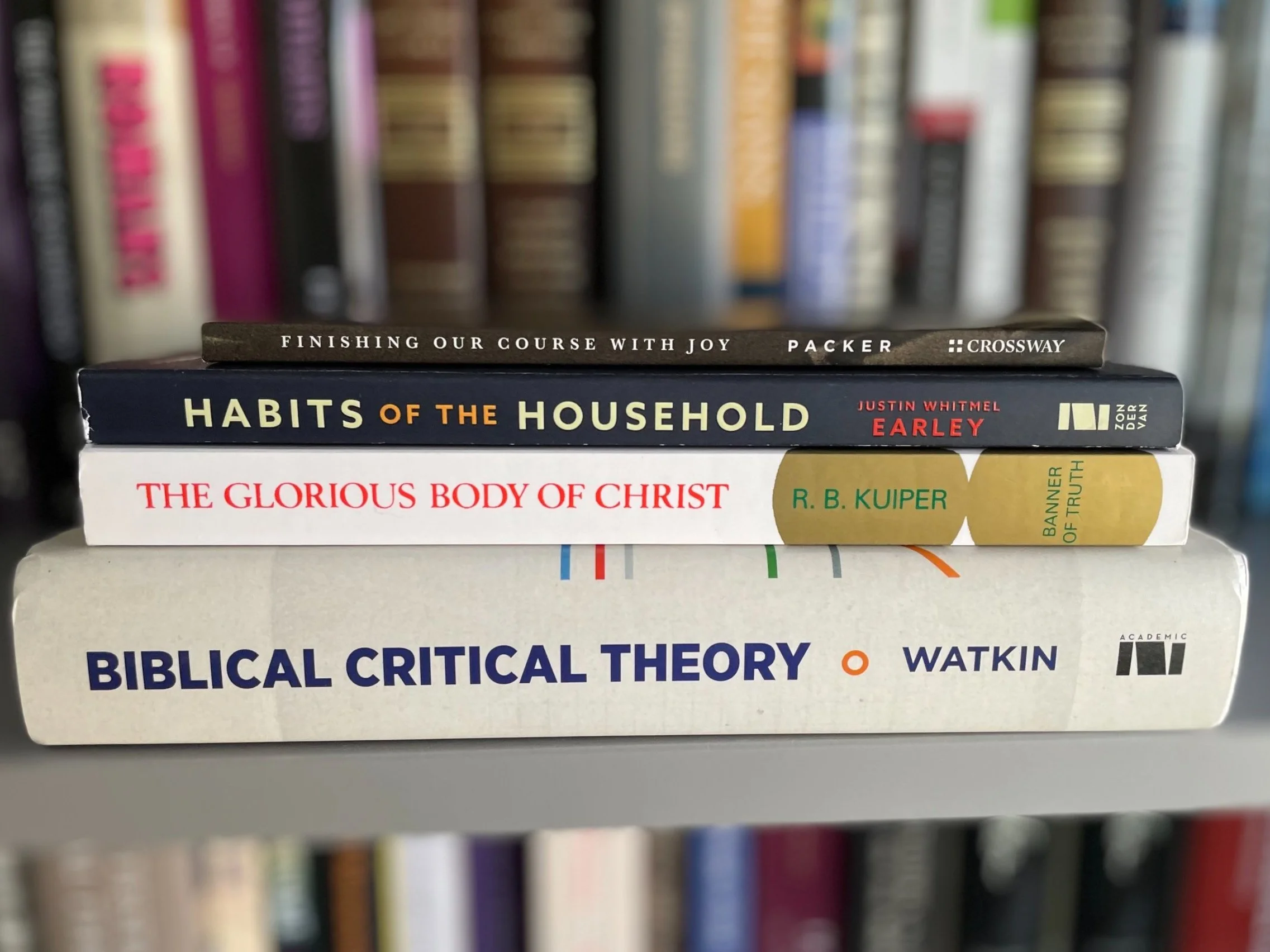
The Glorious Body of Christ by R.B. Kuiper: a great introduction to ecclesiology (the doctrine of the church) from a key leader in the early days of the OPC.
The short chapters make this an ideal book to read daily and reflectively. If you read this, you will grow not only in your understanding of the church but also in your love for the church—the bride of Christ for which He laid down his life.
The Air We Breathe: How We All Came to Believe in Freedom, Kindness, Progress, and Equality by Glen Scrivener: As opposition to the Christian faith seems to grow, what many opponents don’t realize is that their opposition to Christianity can only exist because they take Christian ideals for granted (as Van Til might say, they are living on “borrowed capital”). This is a great book to read yourself and share with friends to encourage them to take a second look at the good news about Jesus.
Right Ho, Jeeves by P.G. Wodehouse: No need to be serious and theological all the time! If you like British humor and a writer who can dazzlingly employ the English language for very silly purposes, you will like this book. I listened to this one on Audible which made people around me wonder why I was laughing so hard.
Finishing Our Course with Joy: Guidance from God for Engaging With Our Aging by J.I. Packer: I don’t think I’m quite in the target audience for this one. But, in another sense, we are all the target audience. This book is a clear call to live for God’s glory and with joy in Christ at any age or stage of life.
... and two still in progress!
Habits of the Household by Justin Whitmel Earley: This is a book that Rebekah and I wanted to buy for every family we know after reading just a few chapters. Especially for families with young children, the author emphasizes the importance of intentional, simple, daily habits on Christian family life. This book draws on wise sources for family life and gives plenty of practical, easy-to-implement advice. In the past I’ve recommended The Common Rule by the same author (and still do!). Habits of the Household is even better!
Biblical Critical Theory by Christopher Watkin: This is one I’ll be reading for a while but I’m very excited about the author’s aim to bring biblical theology into conversation with every dimension of our contemporary life. We, and our views, always need to be challenged by God’s Word—and that’s what Christopher Watkin sets out to do. You can be sure that many of the ideas in this book will be coming to a sermon or Sunday School class near you!
End-of-Year Giving at CPC
December 6, 2022
Dear CPC Family,
As the year comes to a close, we’ve all received a number of requests for financial giving from many worthy causes: non-profits, schools, ministries, and other organizations. I know that my email inbox was quite full last week after Giving Tuesday! It’s easy to experience “giving fatigue,” but I want to encourage and invite you to give to Corona Presbyterian Church before the end of the year.
Financial Strength: Let me be clear at the outset: CPC is in a strong financial position. Giving this year compares well with previous years. Thanks to your generosity and multi-year support from our denomination and presbytery, we also have a healthy reserve fund balance. We are in a position to invest in faithful ministry in 2023. The Lord has blessed Corona Presbyterian Church!
Real Need: At the same time, CPC has real financial needs that will materialize in the coming year. Beginning in 2023, we will no longer receive outside support from the OPC or the Presbytery of Southern California. It’s like the first time riding a bike without training wheels: the only way to know you’re ready is simply to push off and ride. As our training wheels come off, I am confident that the Lord has brought us to this point to multiply our ministry in this corner of Riverside County.
Budget: Our most recent financial update (from mid-November) has us at approximately 80% of our 2022 budgeted giving goal. This is not an unusual place to be at this time of year as so much giving happens in December, but we all need to give to finish strong.
Here's a staggering promise for both giving and ministry from 2 Corinthians 9:8:
“And God is able to make all grace abound to you, so that having all sufficiency in all things at all times, you may abound in every good work.”
Would you make a gift to CPC before the end of December to help us meet or exceed our budget goal?
CPC Members and Regular Attenders: How has the Lord’s grace abounded to you this year? Do you need to catch up on your planned giving for 2022 or are you in a position to give a special offering at the end of the year?
Friends of CPC, Near and Far: Give first to your own local church! But if you’re in a position to give an extra gift to Corona Presbyterian Church, we would be humbled by that generosity.
Any gift, big or small, makes a difference for a strong finish to 2022!
Ways to give:
In-Person: there are three more Sundays in 2022 where you can give in-person.
By mail: you can direct gifts by mail to: Corona Presbyterian Church, c/o Treasurer, 3077 Bighorn Drive, Corona, CA 92881. [Note: IRS rules stipulate that gifts must be postmarked on or before 12/31 to be counted in 2022.]
Appreciated Stock: shares of stock, mutual funds, and other securities can be given to CPC. If you would like to give in these ways, please contact our Finance Team for assistance.
Thank you for your generous hearts as we close the year well!
In the Father’s Love,
Pastor Andrew
Advent & Christmas at Corona Presbyterian Church
November 29, 2022
Dear CPC Family,
The Advent and Christmas season is upon us!
Because this time of year can be so busy, I want to remind you of the opportunities for worship, fellowship, and outreach at Corona Presbyterian Church. One way to combat the busyness of the Christmas season is a gift from God that is available all year-round: remember the Lord’s Day as a day of worship, rest, and feasting. Let me urge you, for your own spiritual health, to prioritize public worship with God’s people!
One unique opportunity 2022 brings is that Christmas Day falls on a Sunday. Hopefully it’s no surprise that we will gather for worship at 9:30am on December 25th. What a privilege it is to celebrate the Lord Jesus Christ coming in the flesh on the day that is already the Lord’s Day!
We’ve heard from people whose own churches are not meeting on Christmas Day who are interested in coming to CPC. Perhaps this is an opportunity for you to invite friends and family to join us for worship and celebration.
Preaching & Worship
We’re taking a break from our Ezra/Nehemiah sermon series to focus on the incarnation of Jesus Christ. This year, our Advent and Christmas sermons will look at Bible passages that teach about Jesus Christ as the True Light. In the words of one of our OPC founding fathers, E.J. Young, “The whole work of Christ and all the blessings which He brings may be characterized by the one word ‘light.’”
Here is the schedule for Sunday morning worship and preaching:
December 4: The True Light (John 1:1-14), guest preacher Rev. Chris Hartshorn
December 11: A Light to the Nations (Isaiah 49:5-6)
December 18: Gospel Light (2 Corinthians 2:1-6)
December 25: The Bright Morning Star (Revelation 22:16)
January 1: The Everlasting Light (Isaiah 60/Revelation 21)
Fellowship & Celebration
The biggest opportunity for fellowship in December will be the CPC Christmas Party at 5pm on December 11th. If you’ve never been, you can expect lots of good food, Christmas-themed games, time to catch up with your church family, and, of course, Pastor Andrew’s Christmas Trivia Extravaganza. We are thankful to the Bray Family for hosting us this year. Be there … and bring friends and family.
Outreach
This coming Sunday evening, December 4th at 5pm, will be one of our significant outreach events of the year. It’s our 4th Annual Christmas Lessons & Carols service. This service of familiar Christmas Carols, Scripture readings, and a short gospel message is a wonderful way to kick off the Christmas season. After you read this, please pray for the Lord’s guidance in who you should invite. And make sure you and your family are there as well. You probably have a few invite cards that you could pass out, but you can also use our Christmas landing page on the CPC website.
If a service of Lessons & Carols is new to you, this article, by a pastor in the URC serving in Washington, DC, is a helpful introduction. Let’s pray that the Lord will use this service to spread the gospel and to remind us all of the Bible’s story of redemption in Christ—from Genesis to Revelation.
So buckle up for a great Advent and Christmas season with your church family! And don’t let this season pass you by without remembering the glory of the incarnation:
“But when the fullness of time had come, God sent forth his Son, born of woman, born under the law, to redeem those who were under the law, so that we might receive adoption as sons. And because you are sons, God has sent the Spirit of his Son into our hearts, crying, ‘Abba! Father!’ So you are no longer a slave, but a son, and if a son, then an heir through God.” (Galatians 4:4-7)
In the Father’s Love,
Pastor Andrew
How to Pray at a Holiday Gathering
November 23, 2022
Dear CPC Family,
As we gear up for family and holiday gatherings, there are many opportunities before us to speak about the glory of God in Christ. I hope you will take them!
One of the most common opportunities many of us will have is when we are asked to pray before meals at holiday gatherings. How can you make the most of this? Here are seven tips:
Plan ahead. You might have a hunch you’ll be asked to pray. It’s better to be prepared than to scramble when the host asks you. Just spend a few minutes thinking through what would honor the Lord and be edifying for those who are gathered with you. Let me encourage you to pray aboutyour opportunities to pray.
Remember your audience. Your primary audience for any prayer is God. It’s always pretty obvious when a prayer is intended to make a point to someone or some category of person in the room. Direct your prayer to God, remembering that we live (and pray) before His face. At the same time, it’s good to think about who will be gathered with you. You may be with a room full of fellow believers. You may be with a group of believers and unbelievers. You may have no idea. You don’t need to “water down” a prayer based on who is there, but some awareness will be helpful. Perhaps there is a special need that you know will be on the minds of many. Perhaps God has shown his mercy in a notable way over the last year. If you know there are unbelievers present, it is very appropriate to pray that the Lord would draw each person there closer to him.
Pray in a way that is fitting for the occasion. It’s good to thank the Lord for the food, for safety in travel, and for friends and family, but this can be pretty general. A Thanksgiving prayer, for example, should have a notably different emphasis compared to a Christmas prayer. Don’t be afraid to praise the Lord for the incarnation of Jesus Christ at Christmas or for his atoning death and glorious resurrection at Easter. After all, these historical events, so central to our faith, are the occasion for the gathering. Get specific!
Use Scripture. This does not need to be lengthy and, in some circumstances, should not be lengthy. But even a short passage from God’s Word is “living and active, sharper than any double edged sword” (Hebrews 4:12). For tomorrow, perhaps you might base a prayer on Psalm 136:1: “Give thanks to the Lord, for he is good, for his steadfast love endures forever.”
Remember what prayer is. Our Confession of Faith defines prayer as “an offering up of our desires unto God, for things agreeable to his will, in the name of Christ, with confession of our sins, and thankful acknowledgment of his mercies.” (Shorter Catechism, Q98) This is a good outline to have in mind as you pray.
Don’t forget the basics. More than once I’ve focused so much on a theologically astute and biblically accurate prayer only to forget to thank God for the food and those who prepared it. Don’t be that guy.
Pray in the name of Jesus. Whenever we pray, we do so through our only Mediator, Jesus Christ. Don’t be afraid to pray in the name of the One who intercedes for us at God’s right hand.
May the Lord bless our holiday gatherings with his presence and remind us all of his great mercies to us and the perfect redemption and new life that is ours through faith in Jesus Christ!
In the Father’s love,
Pastor Andrew
A Moment to Celebrate
November 15, 2022
Dear CPC Family,
The moment we’ve been praying for and working toward for six years is almost here: on this coming Sunday evening, Corona Presbyterian Church will become a new congregation of the Orthodox Presbyterian Church at our 5pm service of recognition and installation.
It promises to be an evening of worship, celebration, and thanksgiving. In God’s providence, this service will be held six years to the day of the first worship service at CPC back in 2016.

This photo was taken on that day. You’ll see some familiar faces as well as some you might not recognize but who are very much part of the story of the Lord’s work at CPC. As you look at this photo, give thanks to the Lord for those he has added to this number since then and the others pictured here who now serve and worship him in other places.
Please do make plans to be with us on Sunday evening. In addition to a number of invited guests from our Presbytery, I know of at least two sister churches that have cancelled their evening worship services in order to join us. This is a big moment we share with our wider OPC family in the regional church of Southern California, Arizona, and Hawaii. We also share it with our brothers in Christ—and facility hosts—at Beth Shalom Messianic Jewish Congregation. We can rejoice that Rabbi Robert Bloch and other leaders from Beth Shalom are planning to be with us on Sunday Evening. It’s an evening you don’t want to miss and a wonderful way to kick off Thanksgiving week!
Because this is a worship service, you can expect to be encouraged by God’s Word both in a sermon and shorter charges (encouraging exhortations):
Dr. Craig Troxel of Westminster Seminary California will be preaching the sermon
Rev. Joel Ellis of Reformation OPC in Apache Junction, AZ will deliver the charge to the congregation
Rev. James Lim of Faith OPC in Long Beach will deliver the charge to the pastor
Because this is a service of installation, we can rejoice as we install our own elder (Brent Murphy), deacon (Ray Sahagun), and pastor (Andrew Canavan) and mark Rev. Chris Hartshorn continuing to serve on the CPC session.
Here’s how you can be involved:
Come to the service! It’s a great celebration but the congregation also plays an important role in affirming the steps that are being taken. We will gather for worship at 5pm (it would not be a bad idea to arrive 10-15 minutes early) and then celebrate with a dessert reception on the patio.
If you can’t be there in person, you can watch the livestream on Facebook Live at 5pm. We will miss you but are thankful you can be with us by digital means.
If you’re able to come early to help with set-up or to greet visitors or stay after to help with clean-up, please contact me.
Whatever you do and wherever you are, would you please pray that the Lord would be honored in this service as we give thanks to him: “The Lord has done great things for us, we are glad.” (Psalm 126:3)
In the Father’s Love,
Pastor Andrew
The CPC Hospitality Challenge
November 7, 2022
Dear CPC Family,
One of my prayers for CPC is that we will grow in the grace of hospitality.
I know some of you hear that word—hospitality—and immediately think of a spotlessly clean home, candle-lit tables, seasonal table runners, and America’s Test Kitchen-vetted recipes. That type of hospitality can be wonderful. But when we think about hospitality in such a limited way, it’s easy to view hospitality as something out of reach.
Here’s a simple, biblical definition of what I mean by hospitality: “Therefore welcome one another as Christ has welcomed you, for the glory of God.” (Romans 15:7)
When we offer a warm welcome, whether a handshake and quick hello on Sunday morning or an invitation to a family dinner later that week, we have an opportunity to reflect the love and grace of Jesus Christ to one another. Hospitality, by this definition, is much more about an open heart than it is about culinary skill or Instagram-worthy home decor. This means that hospitality is a gift that every Christian can use to bless others.
“Hospitality,” Tim Keller once said, “is essentially treating others as family.”
When you think of our welcome of others as Jesus welcomes us, think of these verses:
“In Christ Jesus you who once were far off have been brought near” (Ephesians 2:13)
“And the Pharisees and their scribes grumbled at his disciples, saying, ‘Why do you eat and drink with tax collectors and sinners?’” (Luke 5:30)
“So then you are no longer strangers and aliens, but you are fellow citizens with the saints and members of the household of God.” (Ephesians 2:19)
You and I are welcomed by Jesus and transformed into those who welcome others in His name. What a great privilege this is!
There are great examples of Christian hospitality in action at CPC—but there’s always room to grow! I want to issue a challenge to Corona Presbyterian Church as we grow together in the grace of hospitality. Between now and the end of the year, commit to at least one extra act of hospitality. Here are some ideas:
Pick a CPC family you don’t already know well and invite them over for dinner during the week.
Look for returning visitors and invite them for lunch after church or out for coffee early in the week (Yes, it’s good for newcomers to meet the pastor … but it can be just as important for them to get to know church members).
Pick a Sunday and aim for two conversations with people at CPC you’ve only briefly greeted before.
Consider expanding your Thanksgiving or Christmas celebrations to include someone who might not have anywhere to go.
Get a Solo Stove fire pit and initiate a neighborhood, driveway Christmas s’mores party.
Some of these take some effort and planning, others take very little. But I predict that this simple challenge will help us all begin to see the many opportunities God gives us to be hospitable every day. God can orchestrate amazing things—gospel conversations, mercy ministry opportunities, invitations to church, and more—when we take one step out of our usual comfort.
I am very intentionally writing this particular pastoral letter now because the Thanksgiving and Christmas seasons present us with so many opportunities to be hospitable and, usually, an even greater than normal willingness to receive the blessing of hospitality. But my hope and prayer is that this practice will be part of our church DNA every season of the year.
Let’s welcome others as Jesus welcomed us, for the glory of God!
In the Father’s Love,
Pastor Andrew
The Reformation Gospel
November 1, 2022
Dear CPC Family,
Yesterday, among other things, was Reformation Day. Perhaps this didn’t register as you handed out candy (hopefully the trifecta: Twix, Reese’s cups, and Hershey bars) or helped your children or grandchildren receive candy. But it’s never too late to remember Reformation Day and, more importantly, to rejoice in the Reformation Gospel.
“For I am not ashamed of the gospel, for it is the power of God for salvation to everyone who believes, to the Jew first and also to the Greek. For in it the righteousness of God is revealed from faith for faith, as it is written, ‘The righteous shall live by faith.’” (Romans 1:16-17)
On October 31, 1517 a little known monk and professor–Martin Luther–nailed 95 points for debate to the social media of his day: the door of the castle church in Wittenberg, Germany. The Gospel was the heart of Luther’s message.
For years before, Luther desperately sought peace with God. But his quest for peace was always frustrated. For one thing, Luther knew the depth of his sin. For another, the medieval church’s prescription for attaining righteousness before God always seemed just out of reach. Luther’s own righteous efforts were like a treadmill: constant effort but never getting anywhere. This spiritual turmoil drove Luther to the Bible.
As he studied Scripture, he came to Romans 1 and the message of a righteousness that comes not by what we do but by who we trust; not by works, but by faith. It’s true righteousness that comes from the outside–from Jesus himself–rather than something we work up inside ourselves.
Finally understanding the message of the Bible, Luther’s burden was removed, his turmoil calmed, and the peace he longed for was his at last. As he described it, “the very gates of paradise opened up before me.”
That same Reformation Gospel brings us relief today. The gospel really is good news. It’s not a demand we must fulfill. Instead, it’s the announcement of what God in Christ has done for us.
Do you seek peace with God? It comes to you as a gift and is received by faith alone in Jesus Christ alone. In the words of Romans 5:1, “Therefore, since we have been justified by faith, we have peace with God through our Lord Jesus Christ.”
When we say that CPC is a Gospel-centered church, this is what we mean. We want those who are far from God to hear this message and be brought near. We want Christians to be refreshed daily by the good news of God’s free grace in Christ. Because we love this message so much, we are constantly on guard against anything that dilutes the gospel in our lives or our church.
Take time this week to reflect on the Scripture passages above and the Reformation-era quotes below–and rejoice in the freedom and new life that is ours in Jesus Christ!
Martin Luther: “So when the devil throws your sins in your face and declares that you deserve death and hell, tell him this: "I admit that I deserve death and hell, what of it? For I know One who suffered and made satisfaction on my behalf. His name is Jesus Christ, Son of God, and where He is there I shall be also!” (From Luther’s 1530 letter to Jerome Weller)
John Calvin: Without the gospel everything is useless and vain; without the gospel we are not Christians; without the gospel, all riches is poverty, all wisdom folly before God; strength is weakness, and all the justice of man is under the condemnation of God. But by the knowledge of the gospel we are made children of God, brothers of Jesus Christ, fellow townsmen with the saints, citizens of the Kingdom of Heaven, heirs of God with Jesus Christ, by whom the poor are made rich, the weak strong, the fools wise, the sinner justified, the desolate comforted, the doubting sure, and slaves free.It is the power of God for the salvation of all those who believe. (From John Calvin’s 1534 preface to Pierre Robert Olivétan’s French translation of the New Testament)
Heidelberg Catechism (Question 60): Q. How are you righteous before God? A. Only by true faith in Jesus Christ. Even though my conscience accuses me of having grievously sinned against all God’s commandments, of never having kept any of them, and of still being inclined toward all evil, nevertheless, without any merit of my own, out of sheer grace, God grants and credits to me the perfect satisfaction, righteousness, and holiness of Christ, as if I had never sinned nor been a sinner, and as if I had been as perfectly obedient as Christ was obedient for me.—if only I accept this gift with a believing heart.
Corona Presbyterian Church, let’s rejoice together in the Reformation Gospel!
In the Father’s Love,
Pastor Andrew
What is a Presbyterian Church?
Dear CPC Family,
Let’s give thanks to God for his grace and provision in bringing us to this point: approved by our Presbytery last Friday to organize as a new congregation!
In the words of some of our youngest members (who I live with), we were a “baby” church and now we’re becoming a “kid” church. That’s a good way to put it. It’s a real milestone but there remains much to do to grow in maturity and ministry capacity. Rest assured that Jesus is building his church in Corona–and we each have a role to play!
There’s an ancient tradition in the church of pastors writing letters to the congregations they serve. I hope this will be an edifying practice for us, especially as we approach a new season in church life.
In this inaugural letter I want to answer the question “What is a Presbyterian Church?”
You may have heard churches like CPC described interchangeably as “Reformed” or “Presbyterian.” Both terms are true, but they’re not interchangeable.
Reformed describes our theology. Presbyterian describes our church government (the way the church is run).
Presbyterian comes from the Greek word presbuteros meaning, simply, “elder.” In a Presbyterian church, church government is entrusted in a special way to elders.
Not only is elder the most common term for church leadership in the New Testament (see 1 Timothy 4:14, Acts 20:17, 1 Peter 5:1), it was also a recognized office of leadership for the Old Testament people of God (see, among many, Exodus 24:9 “Then Moses and Aaron, Nadab, and Abihu, and seventy of the elders of Israel went up”).
In the centuries between the early church and the Reformation, a lot of unnecessary complexity was added to the government of the church. The Reformed branch of the Protestant Reformation, especially in Scotland, recovered the biblical understanding of church government by godly elders.
What Does This Look Like in Practice?
Within the OPC there is no elaborate church hierarchy. Instead elders lead at every level, always as undershepherds of Jesus Christ, the Great Shepherd, and ministers of his Word:
The Local Church: the government of each local church is entrusted to their own elders, known as the Session.
The Regional Church: the government of the regional church is entrusted to the elders within that region at gatherings of the presbytery throughout the year.
The Whole Church: our denomination is governed by the elders who represent the various presbyteries at the annual General Assembly.
Is Presbyterian church government essential to the existence of a church? No. Plenty of faithful churches do not have a Presbyterian form of government. Is Presbyterian church government important to the well-being of a church? Yes (but, of course, I am biased!).
How does Presbyterian government foster a healthy church?
Here are a few ways:
Plurality: the pastor does not call the shots. At every level, decisions are made by deliberation as a whole governing body.
Transparency: we’re not making this up as we go along! Everything about how CPC runs is laid out in our Book of Church Order–especially those areas (like worship, church discipline, and changes in church leadership) that tend to create controversy in a church.
Accountability: CPC is accountable to our presbytery and our presbytery is accountable to the general assembly. If anything goes awry with our teaching or practice, there is a built in way to address and correct those problems. Additionally, members can appeal to a higher governing body if they seriously disagree with decisions made at the local church level. For a biblical example of this, read Acts 15.
Patience: it is a feature and not a bug that decisions can take time within a smoothly running Presbyterian church. Our form of government requires us to approach important questions with diligence, prayer, and deliberation.
No, OPC does not stand for “Only Perfect Church.” Any form of church government can be abused. But we should be very thankful for the shoulders we stand on and the biblical heritage of church government they have passed on to us.
For Further Study
Our CPC 101 class covers church government and I am always happy to talk to you about why we do things the way we do.
If you’d like to read more about church government, here are a few recommendations:
The Book of Church Order: it’s not particularly exhilarating reading but this will give you a clear explanation of the essentials.
The Glorious Body of Christ by R.B. Kuiper: a very readable and accessible book on the doctrine of the church.
How Jesus Runs the Church by Guy Waters: if you’d like to consider the biblical basis for Presbyterian government, this book, by a PCA minister and seminary professor, is the go-to.
As we move forward by God’s grace, we move forward as a Presbyterian church.
In the Father’s love,
Pastor Andrew
P.S. You can see Presbyterian church government in action at CPC’s service of recognition and installation on November 20 at 5pm. This worship service will also be a meeting of the Presbytery of Southern California. Be there!